Molecular Biology and Biochemistry
Introduction
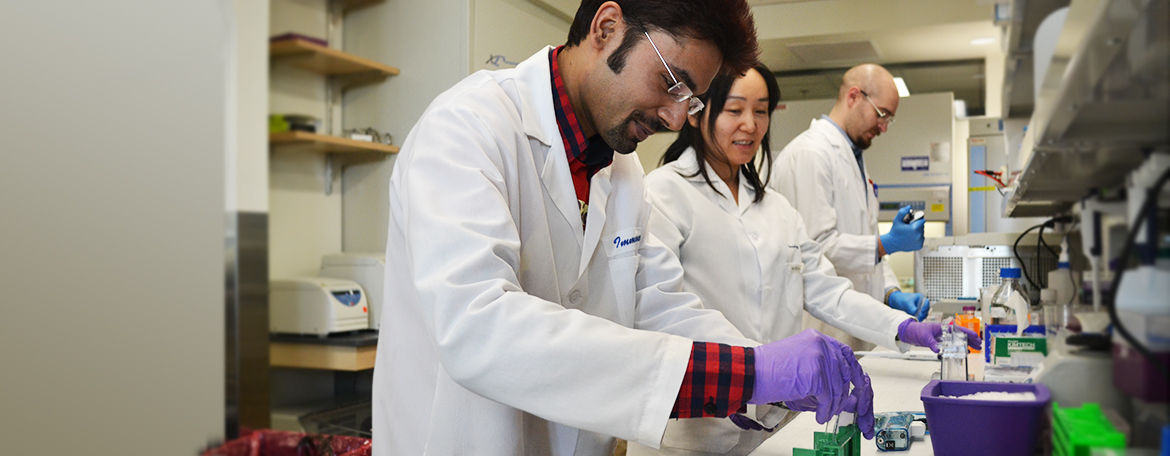
The goal of the Ph.D. graduate program in Biomedical Science at UConn Health is to educate individuals dedicated to pursuing careers as scientists and scholars in biological and biomedical science in a wide variety of settings including academia, the private sector and in government service. To achieve this goal an academic environment is maintained which fosters creative thinking and supports programs leading to excellence in scholarship, research and teaching. The program is dedicated to quality education tailored to the needs of the individual student.
UConn Health is the health sciences campus of the University. It is home to a division of the Graduate School, the School of Medicine and the School of Dental Medicine. UConn Health offers a wide range of educational and research opportunities with talented faculty pursuing exciting and innovative research on contemporary problems in biology and medicine.
Program Description
1st year students enter the Biomedical Science Ph.D. program register for MEDS 6503: First Year Graduate Experience in Biomedical Science. This new year-long course encompasses the three required laboratory rotations as well as an initial exploration block during which students can learn more about all seven Areas of Concentration (AoCs):
- Cell Biology
- Genetics and Developmental Biology
- Immunology
- Molecular Biology and Biochemistry
- Neuroscience
- Skeletal Biology and Regeneration
- Systems Biology
allowing them time to consider and select rotation labs. This course gives students the opportunity to become familiar with ongoing research at UConn Health and obtain a sound academic foundation for future study. Many laboratories representing diverse scientific areas are available for graduate student research rotations and doctoral dissertation research. After the first year, each student selects a thesis laboratory and affiliates with one of the AoCs to develop competency in their desired scientific discipline.
Prospective Students
Prospective students can find more information on our program here: https://health.uconn.edu/graduate-school/prospective/
Questions about admissions? Please contact BiomedSciAdmissions@uchc.edu
*Important Update*
The GRE General Exam is no longer required NOR considered for admission to the Biomedical Science Ph.D. program.
The application for Fall 2024 will open in mid-September. The deadline for application, application fee, and supporting materials for Fall 2024 is December 1, 2023. For detailed application information, please visit our Admissions Process page.