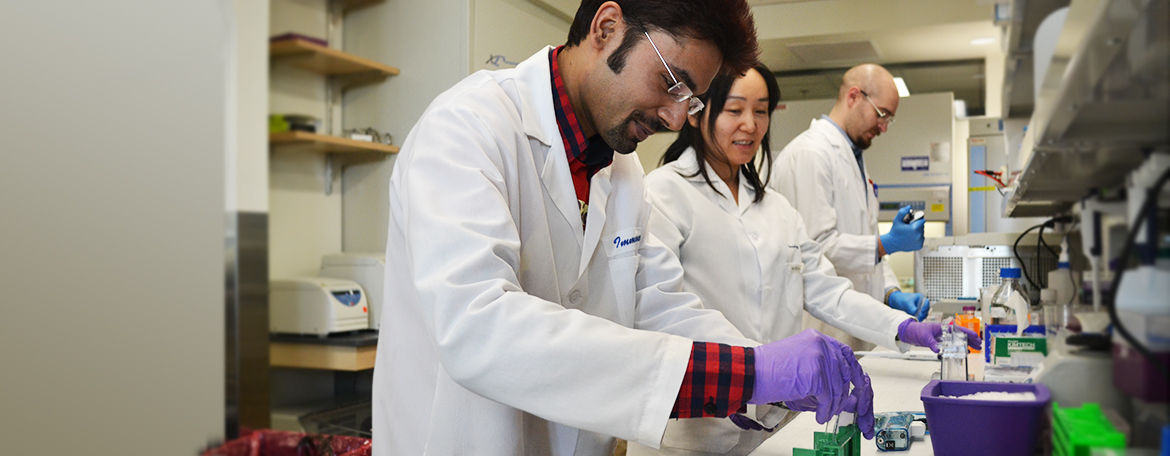
Immunology Graduate Program
Program Description
The immunology graduate program emphasizes several areas,
including:
- Molecular immunology; mechanisms of antigen
presentation; T cell receptor genetics, major
histocompatibility complex genetics and function; cytokines
and cytokine receptors, tumor antigens.
- Cellular immunology; biochemical mechanisms and
biological aspects of signal transduction of lymphocytes and
granulocytes; requirements for thymic and extrathymic T cell
development; cytokines in B and T cell development;
immunotherapy of tumors and infectious disease;
immunoparasitology including parasite genetics and immune
recognition of parasite antigens; mechanisms of
inflammation.
- Organ-based immunology; immune effector mechanisms of
the intestine; lymphocyte interactions in the lung; immune
regulation of the eye.
- Autoimmunity; animal models of autoimmune disease,
effector mechanisms in human autoimmunity.
In addition to basic and advanced immunology courses, the
student is given a strong foundation in basic biomedical
sciences through the "core curriculum" in genetics, molecular
biology and cell biology. Research laboratory training aims to
provide a foundation in modern laboratory technique and
concentrates on hypothesis-based analysis of projects.
Background
The Ph.D. Program in Immunology was approved by the Graduate
School of the University of Connecticut in 1969. It was
activated in 1971 coincident with the start of the NIH Training
Grant, Basic Immunology and Immunological Cell Injury.
Currently, the Immunology Graduate Program (IGP) has 21 faculty,
which collectively in the last ten years trained 124 students
and 120 postdoctoral fellows. Presently there are 16 graduate
students supported by University Fellowships or faculty grants.
Since the beginning of the training grant, 63 students received
their Ph.D., 3 of whom received their Ph.D.
Graduates of the Immunology Graduate Program continued their
postdoctoral training and/or hold positions at:
- University of Connecticut Health Center
- New York University
- University of Michigan
- Harvard University
- Biopolymer Inc.
- University of Tokyo
- Laval University
- University of Iowa
- Yale University
- Boehringer-Ingelheim Inc.
- State University of New York
- Albany Medical Center
- National Institutes of Health
- Tufts University
- University of North Carolina
- Alton Jones Science Center
- Brown University
|
- Johns Hopkins University
- University of Massachusetts
- Miles Laboratories
- Columbia University School of Dental and Oral
Surgery
- Dana Farber Cancer Center
- Jackson Laboratory
- Pfizer
- University of Southern California
- Saint Francis Hospital and Medical Center,
Hartford, CT
- V.A. Medical Center, Newington, CT
- Ohio State University
- Fox Chase Cancer Center
- Scripps Clinic and Research Foundation
- Food and Drug Administration, Washington, D.C.
|
Training
The doctoral degree (Ph.D.) program in Immunology at the
University of Connecticut Health Center is designed to prepare
students to become immunologists capable of undertaking careers
encompassing independent scholarly work at universities,
institutes or the private sector in any aspect of modern
immunology. To achieve this, the philosophy of the Program is
that an effective training program must have: (1) a faculty that
will encourage the student to cultivate his or her own
intellectual powers and creative abilities; (2) be organized in
a manner to allow enough independence and interactions of the
students and faculty in the formulation and execution of
research and training; and (3) sufficient facilities and
equipment available to allow the student to develop technical
skills. In this way, each student will be provided with the
necessary conditions to obtain independence as a scholar.
Coursework is used to give a student a vocabulary and knowledge
of most areas of immunology, basic cell biology, biochemistry,
and genetics. Elective coursework provides a background in other
basic biomedical sciences. It is the philosophy of this Program
that only by placing the maximal amount of responsibility upon
the student, compatible with his or her abilities, can effective
and creative investigators/teachers be developed.
Admission
Admission to the Immunology Program at the UConn Health
Center requires the fulfillment of the requirements of both the
Graduate School of the University of Connecticut, as well as
those of the Immunology Graduate Program.
A. Graduate School Requirements: Acceptance by the
Graduate School is required in addition to acceptance by the
Program. The Graduate School requirements are as follows:
- Bachelor’s degree or equivalent
- A minimum cumulative Grade Point Average of at least 3.0
where: A = 4.0, B = 3.0, C = 2.0, and D = 1.0
B. Immunology Graduate Program Requirements: The
Program seeks individuals of outstanding merit with a record of
high achievement in science, a background in biology and
chemistry, and a full commitment to the biomedical sciences.
Evidence of exceptional scientific ability must be provided by:
- Cumulative grade point average of at least 3.4 in a
rigorous basic science program at the college level and/or;
- Outstanding performance in a research laboratory.
- Strong GRE scores in verbal, quantitative, and
analytical sections.
- Strong recommendations by faculty at the student’s
institution.
- A favorable interview by Program faculty (when
feasible).
The use of the above five criteria provide flexibility in
admission. For example, a student’s overall GPA may be somewhat
below 3.4, but GRE scores, experience in science and a GPA of
the last two years indicates promise as a graduate student. Some
of these students are admitted on a one-year probationary status
and remain in the Program if satisfactory (B or better) academic
performance is achieved and maintained.
The Program recognizes the wide variety of backgrounds of
persons attracted to immunology and does not, therefore, insist
upon a specific preparation for entry into the Program. The
courses listed below have been found generally to be of most
value to entering students:
- Mathematics through differential and integral calculus.
- Courses in inorganic, organic, physical chemistry or
biochemistry.
- One year of general physics.
- One year of general biology, including laboratory.
Students arranging programs of study preparatory to entry
into the Program are encouraged to consider the following
courses:
- Immunology
- Histology
- Cell Biology and Cell Physiology, Biochemistry, General
Physiology, Genetics
- Statistics
- Microbiology
Graduate student support (tuition, fees, supplies, travel,
stipend) are provided by: Health Center Graduate Research
Assistantships, extramural training grants or grants awarded to
Program faculty. The University of Connecticut Health Center
provides supplemental monies to students supported by NIH
training grants.
A downloadable paper application, as well as detailed
information on the application process, is available on our
Admissions page. Applications and all related materials should
be sent to:
Graduate Admissions Office
University of Connecticut Health Center
263 Farmington Avenue, MC 3906
Farmington, CT 06030-3906
The deadline for receipt of all materials is DECEMBER 15.
If you have questions, please contact Ms. Tricia Avolt at
robertson@nso2.uchc.edu
or 860-679-2175.
Candidates for admission are required to take the Graduate
Record Examination and to submit their scores with their
application to the above address. Foreign students are also
required to take the TOEFL Examination and submit their scores,
in addition to the GRE scores.
Curriculum/Course of Study
A total of approximately 40 semester hours of graduate level
course credits and research credits is required of students
entering the Doctoral Program at the bachelor’s degree, and 20
hours for the students entering with a master’s or other
advanced degree. The required number of credits may be made up
of courses in the "core" curriculum (see below) or other
advanced specialized courses from other Graduate Programs. This
includes all courses numbered in the 300 or 400 series. Student
must complete a minimum of 15 credits of Graduate Research,
typically fulfilled with GRAD 495.
First Year
|
- MEDS 350, 351 Biochemistry 1 semester – 5 credits
- MEDS 329 Core Immunobiology 1 8 week session – 2 credits
- MEDS 330 Mechanisms of Immunity 1 8 week session – 2
credits
- MEDS 335 Advanced Molecular and Cellular Immunology,
Part I 1 semester – 4 credits
- MEDS 497 Journal Club 2 semesters – 2 credits
- MEDS 496 Laboratory Rotation 2 semesters – 2 credits
- Rotation Colloquium 1 semester
- MEDS 380 Cell Biology1 semester – 4 credits
|
Second Year
|
- MEDS 365 Genetics 1 semester – 3 credits
- MEDS 335 Advanced Molecular and Cellular Immunology,
Part II 1 semester – 4 credits
- MEDS 497 Journal Club 2 semesters – 2 credits
- MEDS 496 Laboratory Research 2 semesters – 2 credits
|
1.
Pass General Examination
2.
Choose Thesis Topic, Write Thesis Prospectus
3.
Begin Thesis Research |
Third Year
|
- GRAD 495 Thesis Research
- MEDS 497 Journal Club 2 credits
- Thesis (Research-in-Progress Seminar)
|
Fourth Year
|
- GRAD 495 Thesis Research as Arranged
- Thesis Research Seminar (Optional If Near Defense) as Arranged
- Write Thesis as Arranged
- Defend Thesis
- MEDS 497 Journal Club – 2 credits
|
|
|